New import regime in Argentina: recognition of foreign certifications
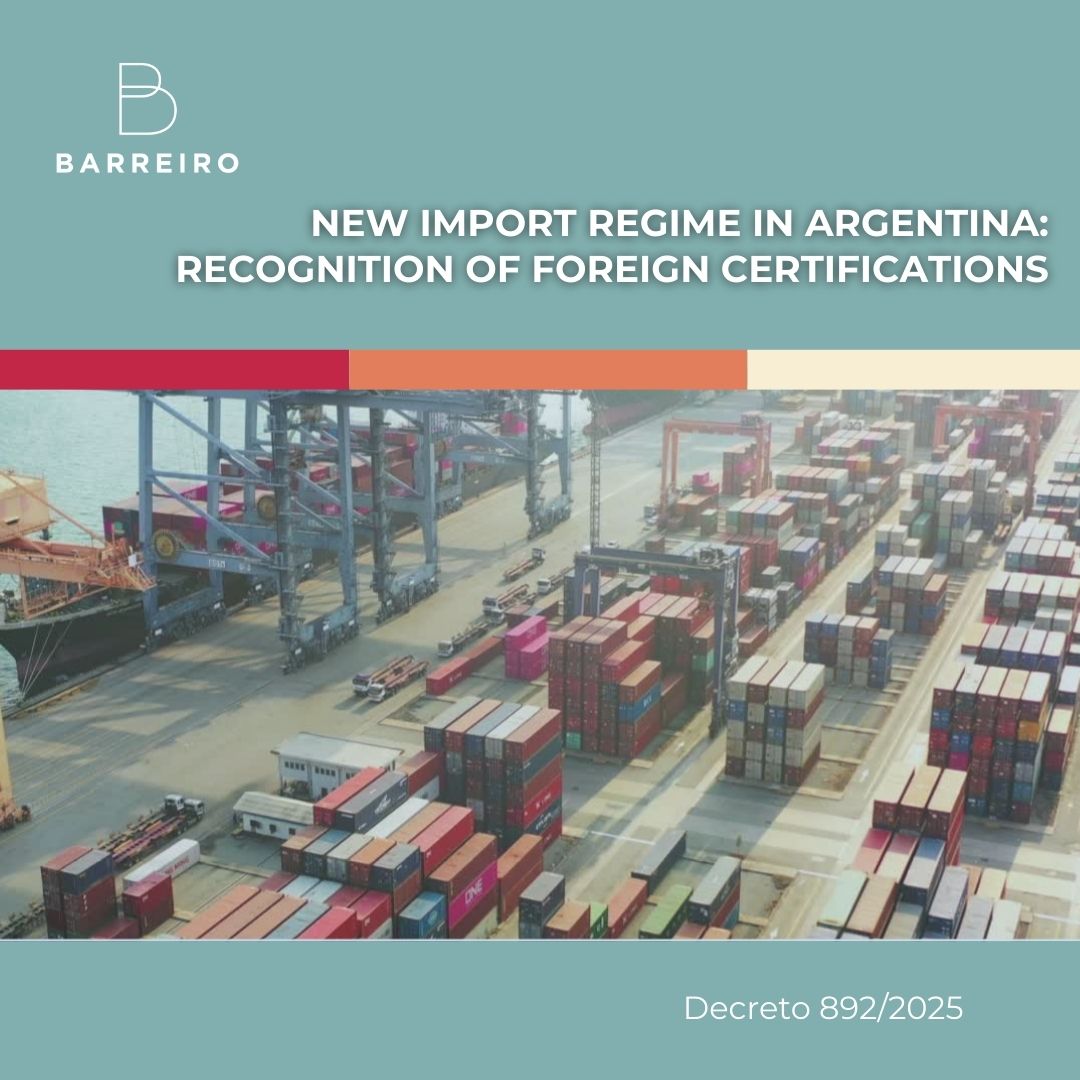
Decree 892/2025 – Products regulated by ANMAT and SENASA. Facilitation of Imports and Commercialization
Purpose
Decree 892/2025 of the Executive Branch establishes a new framework for the importation and commercialization of goods in Argentina, based on the recognition of foreign certifications and technical authorizations, with the aim of simplifying procedures, reducing costs, and eliminating non-tariff barriers.
Scope
It applies to most industrialized goods. Under specific conditions, it includes products regulated by ANMAT (low- and medium-risk products) and SENASA (veterinary and phytosanitary products), while expressly excluding food products, medicines, primary products, used goods, and other items subject to special regimes.
Core change of the framework
Local technical requirements are deemed fulfilled when the product:
-
Is authorized for commercialization in reference countries or blocs, or
-
Holds certifications from accredited bodies, or
-
Has test results from accredited laboratories, whether domestic or international.
The mandatory system of prior technical control in Argentina is abandoned, and an international regulatory equivalence model is adopted, in line with WTO agreements.
Operational impact
-
Significant reduction in import times and costs.
-
Greater regulatory predictability for importers and distributors.
-
Express limitation of customs discretion, which may only apply existing selectivity and risk analysis mechanisms.
ANMAT and SENASA retain oversight and sanctioning powers but cease to function as a prior technical blocking authority.
Risks and safeguards
The system relies on sworn statements and external certifications, which increases the risk of fraud.
To mitigate this, the decree provides for:
-
A strict sanctions regime (customs, health, criminal, and consumer protection).
-
Powers of exclusion on sanitary grounds, without constituting non-tariff restrictions.
Strategic reading
The decree represents a structural shift in Argentina’s trade policy, aligning the country with WTO/OCDE standards and prioritizing trade facilitation over bureaucratic control. Its success will depend on the quality of ex post enforcement and on complementary policies for sensitive productive sectors.
Entry into force
It will enter into force 60 days after its publication in the Official Gazette, with progressive implementation pursuant to supplementary regulations.